Notice Savings Accounts require you to give a set number of days’ notice before withdrawing your cash. In exchange for this commitment, banks generally reward you with higher interest rates than standard easy access accounts, making them perfect for your short term financial goals.
Affiliate Disclosure: We may receive a fee if you click our links or open an account. This does not influence our results, costs you nothing and helps keep our content free.
Up to 30 Days Notice
Up to 60 Days Notice
Up to 90 Days Notice
Up to 180 Days Notice Accounts
Types of Notice Savings Accounts
- Quick Access: Designed for savers who want slightly better returns but might need cash relatively quickly.
- Notice Period: Requires a brief warning, typically 7, 14, or 30 days, before a withdrawal can be processed.
- Lower Premium: Offers lower interest rates compared to longer notice options because the money is not locked down for long.
- Higher Yields: Ideal for individuals saving for planned milestones like weddings, holidays, or mortgage deposits.
- Notice Period: Commonly structured around 60, 90, 120, or 180 days of advance notice.
- Rate Advantage: Rewards patience with significantly higher interest rates, as the bank can rely on the funds for longer.
- Variable Notice: Features interest rates that fluctuate based on market conditions or central bank base rates.
- Fixed Notice: Guarantees a set interest rate for a specific term, combining a notice requirement with fixed returns.
- Online/App-Only: Managed entirely through digital platforms, frequently offering the most competitive rates due to low bank overheads.
- Branch/Postal: Designed for savers who prefer managing their money via post, phone, or in person at a physical branch.
- What is a Notice Savings Account?
- How do Notice Savings Accounts work?
- What are the benefits of a Notice Savings Account?
- What are the disadvantages of Notice Savings Accounts?
- How much notice do I need to give to withdraw my money?
- Can I withdraw money early from a notice account?
- Are Notice Savings Accounts safe?
- Do I have to pay tax on my Notice Savings Account?
- What is the difference between a notice account and a fixed rate bond?
- What is the difference between a notice account and an easy access savings account?
- Who is a Notice Savings Account best for?
- Can I open a Notice Savings Account as a joint account?
- How do I choose the best notice savings provider?
- What happens if my bank changes the notice account terms?
- How do interest rates on notice accounts change?
What is a Notice Savings Account?
A Notice Savings Account is a type of savings account that requires you to give your bank or building society a set amount of warning before you can withdraw your money. Unlike an easy access account where you can take your cash out instantly, a notice account locks your funds away until your notice period ends.
These notice periods typically range from 30 days to as long as 120 days. In exchange for giving up instant access to your money, providers usually reward you with a higher interest rate than you would get on a standard easy access account. It is designed for savers who want better returns but still want the flexibility to access their cash a few times a year without paying a massive penalty.
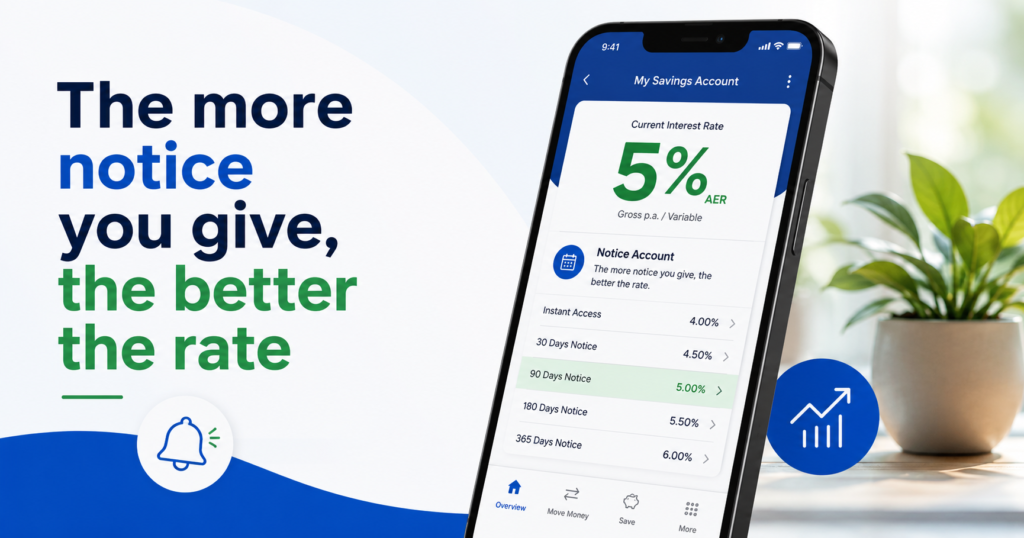
How do Notice Savings Accounts work?
Operating a Notice Savings Account involves a specific process. When you open the account, you agree to the provider’s terms, which include the specified notice timeline. You can deposit money into the account, and it will start earning interest immediately.
When you decide you need to spend some of that money, you cannot simply transfer it to your current account on the same day. Instead, you must log into your online banking, use their app, or call your provider to give a ‘notice of withdrawal’.
If you have a 90-day notice account, your 90-day countdown begins the moment you make this request. Once those 90 days pass, the money is released into your designated current account.
What are the benefits of a Notice Savings Account?
The primary benefit of Notice Savings Accounts is the balance they strike between growth and accessibility.
- Higher Interest Rates: They almost always pay higher interest than easy access alternatives because the bank has more predictability over its funds.
- Saves You From Impulse Spending: Because you cannot get the cash immediately, it forces you to pause and think. This makes it an excellent tool for holding emergency funds that you truly hope not to touch unless a genuine crisis arises.
- More Flexible Than Fixed Bonds: Unlike a one-year or two-year fixed-rate bond, your money is never locked away indefinitely. You are always, at most, a few months away from your cash.
What are the disadvantages of Notice Savings Accounts?
While they offer great perks, Notice Savings Accounts also come with distinct drawbacks that might not suit every saver.
- Lack of Immediate Liquidity: If your car breaks down or your boiler bursts today, a 90-day notice account will not help you pay the mechanic or plumber this afternoon.
- Variable Interest Rates: Most notice accounts have variable rates. This means the bank can lower your interest rate at any time, unlike fixed bonds which lock your rate in.
- Missed Opportunities: If interest rates rise across the market, your money is stuck waiting out the notice period before you can move it to a better-paying competitor.
How much notice do I need to give to withdraw my money?
The amount of notice you need to give depends entirely on the specific account you choose when signing up. Providers categorise these accounts by the exact number of days you must wait.
The most common durations available on the high street and through online banks are 30-day, 60-day, 90-day, and 120-day accounts. A few niche providers might offer 45-day or 180-day options. You must weigh up your need for speed against the interest rate on offer, as longer notice periods generally translate to higher interest rewards.
Can I withdraw money early from a notice account?
The short answer is: usually no, and if you can, it will cost you. The entire structure of a Notice Savings Account relies on you honouring the notice timeline.
Some providers strictly forbid early withdrawals under any circumstances, meaning your money is completely inaccessible until the countdown ends. Others may allow emergency access, but they will penalise you heavily by docking your interest. For example, if you withdraw money instantly from a 90-day account, the bank might deduct 90 days’ worth of interest from your withdrawal, which could mean you walk away with less than you put in.
Are Notice Savings Accounts safe?
Yes, Notice Savings Accounts are incredibly safe, provided you choose a regulated UK bank or building society.
Any authorised financial institution in the UK is backed by the Financial Services Compensation Scheme (FSCS). This government-backed safety net protects your savings up to £120,000 per person, per financial institution. If your bank goes bust, the FSCS is legally required to return your money to you, usually within a matter of days. If you hold more than £120,000, it is wise to split your cash across different banking groups to ensure everything is covered.
The FSCS protects up to £120,000 per person per banking licence, meaning different trading names and sister banks may share a single licence. This will combine their limit into one total.
A full list of sister bank and providers are available HERE

Do I have to pay tax on my Notice Savings Account?
Whether you pay tax depends on how much interest you earn across all your accounts and your personal income tax bracket.
Thanks to the Personal Savings Allowance (PSA), basic rate taxpayers can earn up to £1,000 of interest per tax year completely tax free. Higher rate taxpayers get a smaller allowance of £500, while additional rate taxpayers receive no tax free allowance at all.
Any interest earned beyond your PSA on a Notice Savings Account will be subject to income tax, which is typically declared and paid through HMRC’s self-assessment or adjusted via your tax code.
What is the difference between a notice account and a fixed rate bond?
The core difference lies in flexibility and rate certainty.
A fixed rate bond locks your money away for a strict, unchangeable timeframe—such as one, two, or five years. During this time, you cannot withdraw your money at all, but your interest rate is guaranteed never to change. A notice account, on the other hand, allows you to get your money out at any time of the year, provided you wait out the short notice period. However, the interest rate on a notice account can fluctuate up or down depending on market conditions.
What is the difference between a notice account and an easy access savings account?
This comparison comes down to speed versus reward.
An easy access account gives you total freedom. You can log into your banking app and move your money out in seconds, making it perfect for everyday emergencies. Because of this ultimate liquidity, banks pay lower interest rates on these accounts. A Notice Savings Account sacrifices that instant availability, requiring you to wait weeks or months for your money, but compensates you for that patience with a noticeably higher interest rate.
Who is a Notice Savings Account best for?
These accounts are ideal for structured savers who have clear visibility over their future financial needs.
If you are saving for a wedding next year, a house deposit you plan to use in six months, or a tax bill due at the end of January, a notice account is a brilliant fit. It keeps your money earning a competitive rate while ensuring you can call upon it precisely when the bills arrive. It is also perfect for people who want to build a secondary emergency fund for long-term protection, keeping it separate from their immediate cash reserves.
Can I open a Notice Savings Account as a joint account?
Yes, the vast majority of financial institutions allow you to open Notice Savings Accounts in joint names.
This is a popular option for couples saving for shared goals like home renovations or holidays. When you open a joint notice account, both parties typically have the right to log in and trigger a withdrawal notice. It is important to note that when savings are held jointly, the FSCS protection doubles to £240,000 for that specific account, providing an extra layer of security for larger household savings.
How do I choose the best notice savings provider?
Choosing the right provider requires you to balance the interest rate against the terms that match your lifestyle.
First, look at the headline interest rate (the AER) to ensure you are getting a top tier return.
Next, look closely at the notice period, do not opt for a 120 day account if you suspect you might need the money in 60 days.
Then, check the minimum deposit requirements; some top paying notice accounts require a starting balance of £1,000 or even £10,000, while others let you start with just £1.
We list the top interest rates for all notice accounts HERE. This list is updated daily
What happens if my bank changes the notice account terms?
If your provider decides to adjust the terms of your account, most commonly by lowering the interest rate, they are legally required to give you advance warning.
Under UK regulations, banks must notify you of a material disadvantageous change well in advance. Crucially, this notification period must give you enough time to execute your notice of withdrawal and exit the account before the worse terms take effect. This ensures you are never unfairly trapped in an underperforming account when market conditions take a turn for the worse.
How do interest rates on notice accounts change?
Interest rates on notice accounts are typically variable, meaning they are influenced by broader economic factors.
- The biggest driver of these rates is the Bank of England’s base rate. When the central bank raises rates to combat inflation, commercial banks usually increase the returns on their notice accounts to attract depositors. Conversely, if the base rate falls, providers will likely cut their savings rates. Because your rate can change, you should regularly monitor your account to ensure it remains competitive relative to the rest of the market.
Summary Checklist for Notice Savings Accounts
A Notice Savings Account requires a set warning period, typically 30 to 180 days, before funds can be withdrawn.
- Offers higher interest rates than easy access accounts in exchange for delayed access.
- Deters impulse spending and serves as a tool for structured savings.
- Features variable interest rates with potential penalties for early withdrawals.
- Accounts are protected up to £120,000 per person, per institution.
Alternative accounts: If a Notice Savings Account isn’t the right account for you, consider these other account types:
Easy-access savings accounts provide a secure, flexible way to earn interest on your cash with total freedom. Since you can withdraw your money instantly without penalties, your funds remain completely available whenever you need them. This flexibility makes them an ideal choice for building an emergency fund or holding short-term cash. We search 100’s of providers to find you the highest interest rates available on the market.
Regular savings accounts offer a structured, rewarding way to build your cash. By committing to save a set amount each month, you unlock some of the highest interest rates available. This predictable routine helps you grow your money consistently while protecting it from volatile markets. It is an ideal choice for building an emergency fund. We compare the full market so you always get the best rates available.
Children’s savings accounts offer boosted interest rates to jumpstart your child’s financial future. You can select the account type that matches your family’s milestones, from flexible instant access accounts to high growth fixed rate bonds. It is a secure was to build a nest egg while teaching your kids lifelong money habits. We scan the entire market to find the highest available rates for your child’s savings.
Monthly Interest Savings Accounts
Monthly interest savings accounts provide a dependable, regular stream of extra income from your cash. Instead of waiting until the end of the year, your interest is paid out every single month. This frequent payout structure makes them an ideal choice for anyone looking to supplement their monthly budget or pension. We compare the complete market to unlock the best rates for your savings.